applied9 min read
Elliptic Curve Cryptography: The Mathematics Protecting the Internet
Why your online banking depends on abstract algebra

Why your online banking depends on abstract algebra
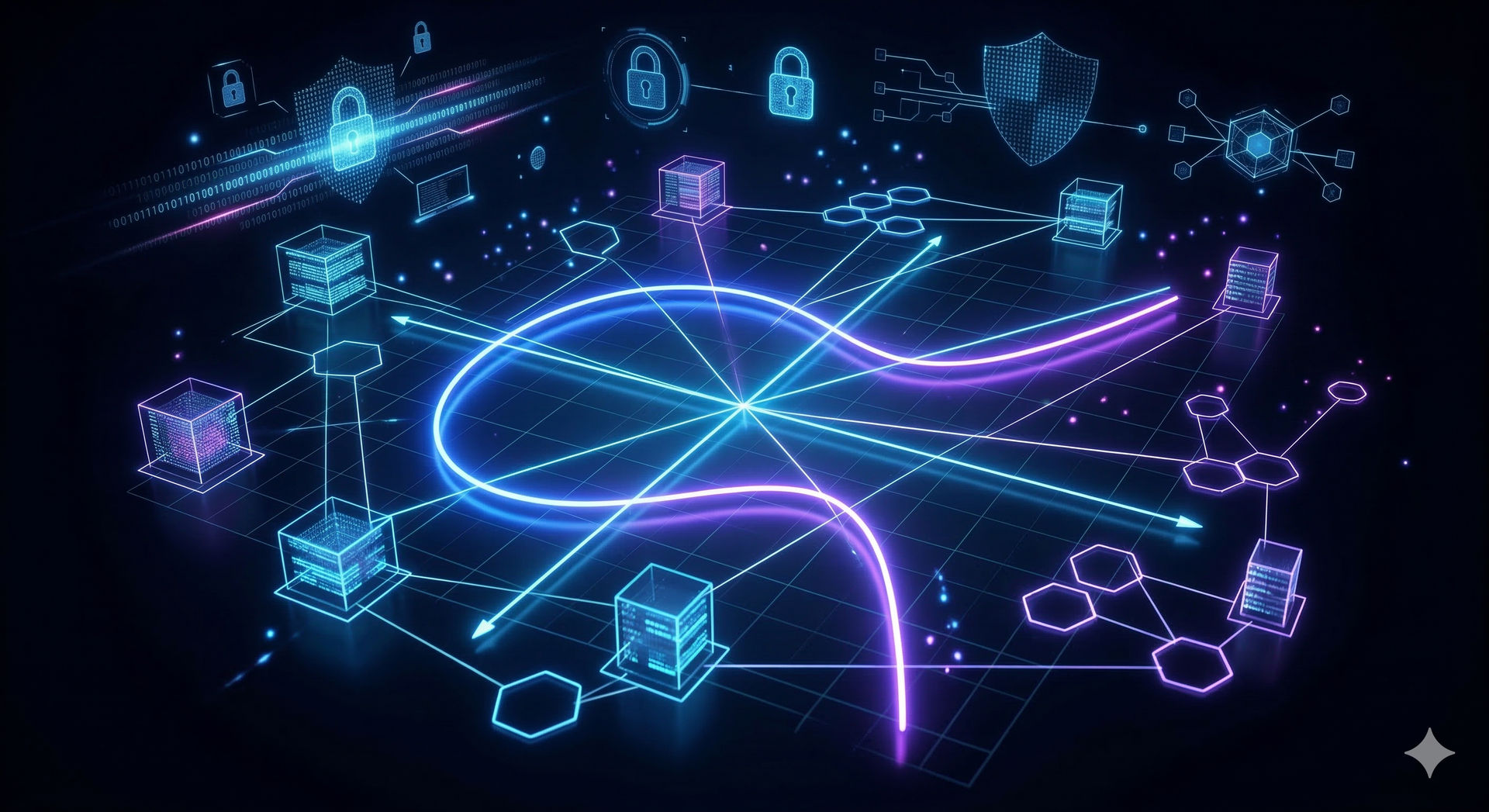
Every time you open your bank's website, your browser and the server perform a silent mathematical ceremony lasting milliseconds. No password changes hands. No secret is transmitted. Yet both parties arrive at the same cryptographic key, and every byte of the session becomes unreadable to anyone else on the network. This miracle is routine infrastructure — and it rests almost entirely on the algebraic geometry of elliptic curves.
Elliptic Curve Cryptography (ECC) is a public-key cryptographic system built on the structure of elliptic curves defined over finite fields. It has largely displaced its predecessors — RSA and classical Diffie-Hellman — in modern protocol design, not because the underlying mathematics is simpler, but because it is harder in the right way: the problem at its core is more computationally intractable per bit than factoring integers, enabling far smaller keys with equivalent or superior security. A 256-bit ECC key provides the same security as a 3072-bit RSA key. At 256-bit security, RSA keys balloon to 15,360 bits while ECC stays at 521.
This article develops ECC from first principles — the algebraic geometry of curves, the arithmetic of finite fields, the group law, the hardness of the discrete logarithm, and the protocols built upon it.
Classical cryptography is symmetric: both parties share a secret key, and security reduces to keeping that key out of adversaries' hands. Caesar's cipher encodes each letter as a shift by a fixed offset :
More sophisticated classical systems — Vigenère, Playfair, Enigma — extend this idea while preserving the fundamental structure. Their shared limitation is the key distribution problem: how do two parties who have never met securely agree on a key before communicating?
The conceptual breakthrough came in 1976, when Diffie and Hellman introduced public-key cryptography: a system where encryption and decryption use different, mathematically related keys. Each party holds a public key (freely distributed) and a private key (kept secret). The relationship is computationally asymmetric — easy to compute in one direction, infeasible to reverse.
The first practical realization was RSA (Rivest, Shamir, Adleman, 1977), grounded in the difficulty of factoring large integers. Given primes and , computing their product is trivial. Recovering and from alone requires time:
This is sub-exponential time — slower than polynomial but faster than exponential. RSA dominated public-key cryptography for decades. But as hardware improved, maintaining an acceptable security margin required ever-larger keys. The computational cost of 3072-bit and 7680-bit modular exponentiations became prohibitive for mobile devices, embedded systems, and large-scale server deployments. Cryptographers needed a harder problem.
An elliptic curve over a field (with ) is a smooth projective curve of genus one with a specified rational base point, admitting a Weierstrass model:
The curve must be non-singular: the discriminant
must satisfy . When , the cubic has a repeated root, the curve acquires a singular point — either a (two distinct tangent directions) or a (a single tangent direction) — and the algebraic group structure that makes elliptic curves cryptographically useful collapses. The non-singularity condition is not a technicality; it is the algebraic prerequisite for the entire theory.
Over , the curve is a smooth plane curve. Its topology depends on the number of real roots of the cubic on the right-hand side: if the cubic has three distinct real roots, the curve has two connected components; if it has one real root and two complex conjugate roots, it has one component. In either case, appending the point at infinity in projective space completes the curve into a compact object.
The profound fact — far from obvious — is that the points on this curve, including , form an abelian group under a geometrically defined addition law. This is the foundation of everything that follows.
Over , elliptic curve arithmetic involves irrational numbers and transcendental computations that computers can only approximate. Cryptography demands exact arithmetic within a bounded set of values. The solution is to move from to a finite field.
A finite field (for a prime ) contains exactly elements: the integers with addition and multiplication performed modulo . Every non-zero element has a multiplicative inverse — by Fermat's little theorem, — so is indeed a field. Crucially, all arithmetic stays within a fixed finite set, with no approximation, no rounding, no accumulating error.
Restricting the Weierstrass equation to yields a discrete point set:
The cardinality of this set is governed by the Hasse bound, one of the landmark results of 20th-century algebraic geometry:
So , deviating by at most . The proof involves the and the Weil conjectures — deep results connecting geometry over finite fields to the zeros of associated zeta functions. For our purposes the import is practical: we can choose so that has roughly elements, giving an enormous group to work in.
By the structure theorem for finite abelian groups:
where and . In the most common cryptographic case is cyclic — isomorphic to — and a single (base point) produces all group elements as integer multiples of .
The addition law on is the chord-and-tangent rule, a construction rooted in Bézout's theorem: a line in meets a smooth cubic curve in exactly three points (counted with multiplicity). Given any two points , the line through them hits the curve at a unique third point; reflecting that third point across the -axis gives .
Point addition (, , ):
Point doubling (, tangent line at ):
with the same formulas for and .
Identity: (the point at infinity) satisfies for all .
Inverse: The inverse of is ; the vertical line through them meets the curve at in projective space.
These formulas work identically in : every division becomes modular inversion, every subtraction and addition is modular, and the result is another point in . The group axioms — closure, commutativity, associativity, identity, inverse — all hold. Associativity is the non-trivial one; its proof requires careful analysis of degenerate configurations in the function field of the curve, but it is rigorous.
The resulting structure is a finite abelian group on which we can perform arbitrary arithmetic — adding, subtracting, scaling by integers — and every result remains on the curve.
The cryptographic engine of ECC is scalar multiplication: given and a positive integer , compute
Naïve repeated addition requires group operations — infeasible when . The double-and-add algorithm (the point analogue of fast modular exponentiation) reduces this to operations by processing bit by bit:
Input:  integer k = (k_{n-1} ... k_1 k_0)_2,  point P
Output: [k]P

Q ← 𝒪
for i from n−1 downto 0:
    Q ← 2Q               ⟵ point doubling
    if k_i = 1:
        Q ← Q + P        ⟵ point addition
return Q
For a 256-bit scalar, this requires at most group operations — microseconds on modern hardware.
The security of ECC rests on the reversal of this computation being infeasible. The Elliptic Curve Discrete Logarithm Problem (ECDLP) is: given points with , recover .
The asymmetry is stark:
For , this means operations — computationally infeasible for any foreseeable classical hardware, representing more operations than there are atoms in the observable universe times a comfortable safety margin.
Compare this to the best attack on RSA (the General Number Field Sieve), which runs in sub-exponential time . ECDLP is in a strictly harder complexity class: no sub-exponential algorithm is known for it over generic curves. This hardness gap directly explains why ECC achieves equivalent security at much smaller key sizes.
| Security Level | ECC Key Size | RSA Key Size | Ratio |
|---|---|---|---|
| 80-bit | 160 bits | 1024 bits | 6.4× |
| 128-bit | 256 bits | 3072 bits | 12× |
| 192-bit | 384 bits | 7680 bits | 20× |
| 256-bit | 521 bits | 15360 bits | 29× |
Why curve selection matters. Not all elliptic curves offer this hardness guarantee. Supersingular curves admit the MOV attack — a Weil pairing reduction that maps ECDLP into a classical discrete logarithm in a small field extension, solvable in sub-exponential time. Anomalous curves () admit the Smart attack, which lifts ECDLP to and solves it in linear time. Standardized curves (P-256, Curve25519, secp256k1) encode years of cryptanalytic scrutiny specifically to avoid these and other structural weaknesses.
Given agreed domain parameters — the prime, curve coefficients, generator, group order, and cofactor — the key generation protocol is:
Private key: Sample d \xleftarrow{\} {1, 2, \ldots, N-1}$ uniformly at random. This integer is the private key; its security is exactly the ECDLP.
Public key: Compute . This point is distributed freely.
Computing from costs group operations. Recovering from is the ECDLP — infeasible for properly chosen parameters.
ECDH solves the key agreement problem: Alice and Bob wish to establish a shared secret over an untrusted channel.
Since in , both arrive at the same point . A shared symmetric key is derived from the -coordinate of via a key derivation function. An eavesdropper who intercepts and must compute without knowing either scalar — the , widely believed as hard as ECDLP for properly chosen curves.
In TLS 1.3, ECDH is run in its ephemeral variant (ECDHE): fresh key pairs are generated for every session, providing forward secrecy — compromise of a long-term private key cannot expose past sessions.
ECDSA enables Alice (with private key , public key ) to produce a signature on a message that anyone can verify with , but only she can produce.
Signing:
Verification (given , , and public key ):
Correctness follows because and:
so the verified point is as intended, whose -coordinate is by construction.
The nonce reuse catastrophe. If the same is used to sign two distinct messages with hash values , producing signatures and , an attacker can compute:
The private key is fully recovered. This exact failure was responsible for the 2010 PlayStation 3 private key extraction (Sony used a fixed for all signatures) and numerous cryptocurrency wallet compromises. Modern implementations either use deterministic nonce generation (RFC 6979) or hardware random number generators with strict uniqueness guarantees.
A significant advance in implementation security came with Edwards curves, whose twisted form over is:
The addition law on Edwards curves is complete and unified — the same formula handles all point pairs, including the identity, with no exceptional cases:
This completeness eliminates the exceptional point vulnerabilities that plague Weierstrass implementations — a class of side-channel and fault-injection attacks that exploit the special-case branches required in the standard addition formulas. The completeness is not merely convenient; it is a security property that Weierstrass curves cannot easily match.
Curve25519, designed by Daniel Bernstein (2006), is a Montgomery curve over . Its associated key agreement protocol and signature scheme (EdDSA on the twisted Edwards form) are now among the most widely deployed cryptographic primitives in existence — appearing in TLS 1.3, SSH, Signal, WhatsApp, WireGuard, and countless other systems.
The efficiency advantage of ECC over RSA derives directly from the complexity class of the underlying hard problem.
Classical discrete logarithm in and integer factorization are both solvable in sub-exponential time via index calculus and the Number Field Sieve. ECDLP, by contrast, admits no known sub-exponential algorithm over generic curves — only the fully exponential of Pollard's rho. Working in the harder complexity class means we can work with smaller parameters and achieve the same (or greater) security.
The practical consequences:
These are not marginal improvements. They are what allow modern smartphones to perform dozens of TLS handshakes per second, maintain secure messaging with forward secrecy per message, and authenticate to dozens of services — all while running on a battery that lasts a day.
Every HTTPS connection is an ECC computation. In a TLS 1.3 handshake negotiating TLS_AES_256_GCM_SHA384 with x25519:
The entire handshake — negotiation, key exchange, authentication — completes in one round trip and under 10 milliseconds. TLS 1.3 does not support RSA key exchange; ECC is mandatory.
Bitcoin and Ethereum use secp256k1 — the curve over with — for all key management and transaction signing:
RIPEMD160(SHA256(Q)), encoded in Base58Check.The approximately 19 million BTC in circulation — hundreds of billions of dollars — are secured by the ECDLP over secp256k1. The hardness of this single mathematical problem is what makes "your keys, your coins" a meaningful guarantee.
Signal Protocol (used in Signal, WhatsApp, and many others) layers multiple ECC primitives:
The result is a messaging system where reading any single message — even with full server compromise — reveals nothing about past or future messages. This property was considered theoretically unreachable two decades ago.
The FIDO2 standard underlying WebAuthn uses ECDSA over P-256 for credential generation and authentication. A physical security key (YubiKey, etc.) generates an ECDSA key pair at registration, stores the private key in tamper-resistant hardware, and signs server-issued challenges at authentication. The server verifies the ECDSA signature against the registered public key — no password ever exists or is stored server-side.
Every public-key cryptosystem currently deployed — ECC included — assumes that the hard problem at its core resists attack by classical computers. Shor's algorithm (1994) proves that a sufficiently large quantum computer can solve discrete logarithms — including ECDLP — in polynomial time where is the bit-length of the group order. For 256-bit ECC, this requires roughly 2,330 logical qubits after error correction, translating to millions of noisy physical qubits with current technology.
No such machine exists today. But the "harvest now, decrypt later" threat model — adversaries recording encrypted traffic now, decrypting once quantum hardware matures — makes the urgency real.
NIST's Post-Quantum Cryptography standardization (concluded 2024) selected four algorithms for standardization:
None of these share ECC's elegant algebraic geometry. They trade mathematical beauty for post-quantum security — a pragmatic concession to the laws of quantum mechanics.
In the interim, hybrid schemes combine classical ECC with post-quantum algorithms so that security holds if either assumption is correct:
TLS 1.3 already supports hybrid key exchange (e.g., X25519Kyber768), and major browsers are actively deploying it.
The chord-and-tangent group law on cubic curves was studied in the 19th century as pure abstract algebra. Galois developed finite field theory in the 1830s while investigating polynomial solvability — a problem of mathematical aesthetics, not engineering utility. The Hasse bound, the Mordell-Weil theorem, the Weil conjectures — these unfolded through the work of Weil, Grothendieck, and Deligne as part of a grand unification of algebraic geometry and number theory, decades before anyone imagined applying them to network security.
None of these mathematicians were thinking about internet banking.
Yet today, every HTTPS lock icon, every blockchain transaction, every Signal message, every passwordless login — all of these instantiate abstract mathematical structures, computed at gigahertz frequencies, protecting communications on a planetary scale. The most widely deployed cryptographic primitives of 2025 are implementations of 19th-century pure mathematics.
For anyone who has wondered why abstract algebra appears in a mathematics curriculum alongside more obviously applicable subjects: this is why. Deep mathematical structures develop their own internal logic, following aesthetic imperatives that have nothing to do with application — and then, decades later, reveal themselves to be precisely what the world needed. ECC is not an application of mathematics to cryptography. It is mathematics, running silently inside every device, doing its job.
Washington, L.C. (2008). Elliptic Curves: Number Theory and Cryptography, 2nd ed. Chapman & Hall/CRC. — The standard graduate-level reference covering both the pure theory and cryptographic applications with full proofs.
Silverman, J.H. (2009). The Arithmetic of Elliptic Curves, 2nd ed. Springer GTM 106. — The definitive advanced treatment of the arithmetic theory; essential for readers seeking depth in the mathematical foundations.
Hankerson, D., Menezes, A., & Vanstone, S. (2004). Guide to Elliptic Curve Cryptography. Springer. — The standard practitioner reference covering algorithms, implementation, and standards in depth.
Koblitz, N. (1987). Elliptic curve cryptosystems. Mathematics of Computation, 48(177), 203–209. — One of the two original papers proposing ECC.
Miller, V.S. (1985). Use of elliptic curves in cryptography. In Advances in Cryptology — CRYPTO '85, LNCS 218. Springer. — The co-originating paper.
Bernstein, D.J. (2006). Curve25519: New Diffie-Hellman speed records. In Public Key Cryptography — PKC 2006, LNCS 3958. — The design paper for Curve25519; a model of verifiable, auditable curve selection.
Bernstein, D.J., & Lange, T. (2007). Faster addition and doubling on elliptic curves. In ASIACRYPT 2007, LNCS 4833. — The seminal paper on Edwards curve arithmetic and the complete addition law.
Shor, P.W. (1994). Algorithms for quantum computation: discrete logarithms and factoring. In FOCS 1994, IEEE. — The paper establishing the quantum threat to ECC and RSA.
NIST FIPS 186-5 (2023). Digital Signature Standard. National Institute of Standards and Technology. — The current US federal standard for ECDSA, defining approved curves P-256, P-384, P-521.
NIST IR 8413 (2022). Status Report on the Third Round of the NIST Post-Quantum Cryptography Standardization Process. — Official documentation of ML-KEM, ML-DSA, SLH-DSA, FN-DSA standardization.

Applied mathematician and AI practitioner. Founder of MathLumen, exploring mathematics behind machine learning and scientific AI.
The computational engine behind topological data analysis, built up from geometric intuition
Persistent homology tracks how loops, clusters, and voids in data survive across scales, revealing shape that means and...
When Fourier meets computation
Spectral methods transform PDEs into algebraic systems using global basis functions. We survey how Fourier and...
Random walks on Wall Street — literally
Monte Carlo simulation is the backbone of derivatives pricing. We explore the mathematics of random sampling, variance...