research8 min read
Topological Data Analysis: Finding Shape in Data
Persistent homology and the topology of point clouds

Persistent homology and the topology of point clouds
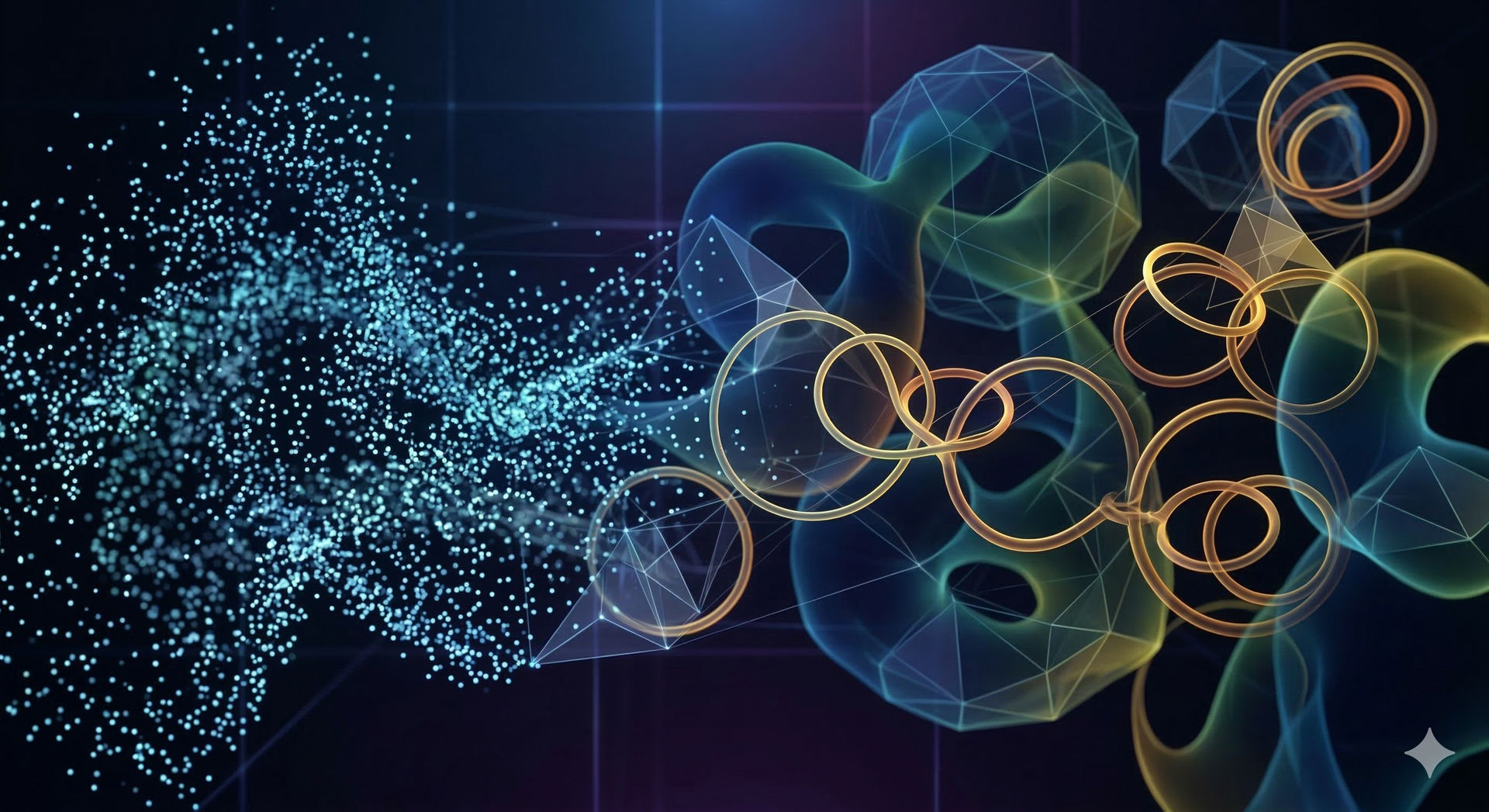
In the nineteenth century, Bernhard Riemann introduced the notion that space itself could be curved — an insight that eventually gave Einstein the mathematical scaffolding for general relativity. A century and a half later, data scientists are confronting an analogous revelation: the datasets that arise in modern machine learning are not featureless clouds of points. They have shape.
Traditional statistical learning theory treats data as samples from a probability distribution supported on some subset of Euclidean space . Linear algebra, PCA, and kernel methods excel when the relevant structure is captured by covariance — when the data lie near a linear subspace or a smooth, convex manifold. But biological sequences, brain activity signals, molecular configurations, and the internal representations learned by deep neural networks rarely respect such assumptions. They organize themselves along intricate, non-convex, topologically nontrivial geometric objects.
Topological Data Analysis (TDA) is the branch of applied mathematics that studies the shape of data rigorously, using tools from algebraic topology. Rather than summarizing a dataset by its mean and covariance, TDA asks: How many connected components does it have? Does it contain loops, voids, or higher-dimensional cavities? Are these features robust to small perturbations, or are they artifacts of noise?
Topology is the mathematics of shape invariant under continuous deformation. Two spaces are topologically equivalent — homeomorphic — if one can be continuously deformed into the other without tearing or gluing. The classic coffee-cup/donut equivalence illustrates this: both possess exactly one hole, and a sufficiently pliable material can be sculpted from one form into the other.
What topology counts are qualitative features that survive deformation: the number of connected pieces, the number of independent loops, the number of enclosed voids. This deformation-invariance is precisely what makes topology useful for noisy data. If one slightly perturbs a point cloud — adding small measurement errors, or subsampling — one wants the inferred structural features to remain stable. A loop in the data that persists across many scales of resolution is genuinely there. A feature that appears at only one scale is likely noise.
The mathematical framework that formalizes this distinction is persistent homology, TDA's central computational engine.
A dataset is initially modelled as a finite metric space: a set equipped with a distance function (typically Euclidean, though geodesic, correlation-based, or kernel-induced distances are common). The goal is to recover topological properties of the underlying space from which was sampled — often a manifold or stratified space — using only finitely many noisy samples.
A simplicial complex is a combinatorial object built from vertices (0-simplices), edges (1-simplices), triangles (2-simplices), tetrahedra (3-simplices), and higher-dimensional analogues. Formally, is a collection of finite sets closed under taking subsets: if and , then . Simplicial complexes are the combinatorial bridge between finite datasets and algebraic topology.
Given a point cloud and a scale parameter , two canonical constructions yield simplicial complexes:
Vietoris–Rips complex : a finite set is a simplex if and only if , i.e., every pair of points in is within distance . This is computationally tractable and is the standard choice in practice.
The key relationship between these complexes is the interleaving:
This sandwich inequality ensures that the two constructions carry the same persistent topological information up to a factor of 2 in scale.
As ranges over , the Vietoris–Rips complexes assemble into a filtration — a nested sequence of simplicial complexes:
Each inclusion induces maps on homology groups, and it is the behavior of these maps across the entire filtration that persistent homology tracks.
Homology is the algebraic machinery that counts topological holes. For a simplicial complex , the -th homology group is computed over a field (usually for computational efficiency) via the chain complex:
where is the free vector space spanned by -simplices, and is the boundary operator. The -th homology group is:
Its rank — the -th Betti number — counts -dimensional holes:
A circle has , . A torus has , , . A sphere has , , .
Persistent homology applies homology to an entire filtration. As the scale parameter increases, simplices are added one by one. Each addition either:
The fundamental theorem of persistent homology (Zomorodian–Carlsson, 2005) states that, over a field, the persistent homology of a filtration decomposes uniquely into a set of interval modules . Each such interval records the birth and death of one topological feature. The multiset of all such intervals is the persistence diagram.
A persistence diagram is the multiset of points with , one for each topological feature. Features near the diagonal () are short-lived and typically represent noise. Features far from the diagonal () represent genuine topological structure of the underlying space.
An equivalent representation, the barcode, plots each interval as a horizontal bar over the axis. Long bars signal robust features; short bars signal noise. A dataset sampled from a circle will display one long bar in (one persistent loop), while data sampled from a torus will display two long bars in and one in .
The stability theorem (Cohen-Steiner–Edelsbrunner–Harer, 2007) provides the rigorous foundation for TDA's robustness: if two functions and are close in the norm, their persistence diagrams are close in the bottleneck distance:
Small perturbations to the data produce only small perturbations in the persistence diagram. This provides an information-theoretically grounded notion of what constitutes a meaningful topological feature versus noise.
While persistent homology is powerful, its output — a set of birth-death pairs — can be difficult to interpret geometrically. The Mapper algorithm (Singh–Mémoli–Carlsson, 2007) addresses this by constructing a graph that summarizes the coarse topology and geometry of high-dimensional data.
The algorithm proceeds as follows:
The resulting graph is a topological summary that has proven remarkably effective for discovering loop structures, branching patterns, and flares in biological and genomic data.
A Reeb graph is the continuous analogue of the Mapper construction: given a smooth function on a manifold , one quotients by identifying points in the same connected component of each level set . The quotient is a graph encoding the topology of the level sets, and it forms the theoretical basis for the Mapper algorithm.
One of the most striking recent applications of TDA is the analysis of decision boundary topology in neural networks. By constructing simplicial complexes from activation spaces of a trained network, researchers have used persistent homology to distinguish networks trained on random labels (complex, convoluted topology) from those trained on structured data — providing a topological lens on generalization.
The Betti numbers of activation spaces change systematically during gradient descent: initially high, reflecting disordered representations, they decrease toward a simpler topology as the network learns structure. This offers new invariants for understanding phase transitions in learning.
Persistent homology is well-suited to time series analysis through the Takens embedding: a scalar time series is embedded in via delay coordinates . The topology of the resulting point cloud encodes the dynamical structure: periodic orbits yield features, toroidal dynamics yield two features, and chaotic attractors exhibit more complex topological signatures.
The Mapper algorithm applied to RNA-seq data from breast cancer patients recovered a subgroup of patients with a distinctive expression profile and uniformly poor outcomes — a discovery missed by standard clustering methods. In structural biology, the persistence diagrams of atomic configurations in protein structures encode features that correlate with stability and function, offering a new class of descriptors for structure prediction pipelines.
Anomalous data points often disrupt the topological structure of the surrounding data. A persistent homology-based anomaly detector identifies points whose removal significantly changes the persistence diagram — these are topological outliers. Such methods have proven effective in detecting anomalies in sensor networks, financial time series, and medical imaging.
Topological deep learning extends message-passing neural networks — which operate on graphs — to higher-order combinatorial domains: simplicial complexes, cell complexes, and hypergraphs. By defining convolution operators on these richer structures, topological deep learning models can capture higher-order interactions and multi-scale relational structure that graph neural networks systematically miss.
Differentiable persistent homology (Brüel-Gabrielsson et al., 2020) enables gradient-based optimization of topological loss terms, allowing models to be trained to have desired topological properties. This opens the door to topology-aware regularization as a principled tool for improving generalization:
where penalizes undesired topological features in the learned representation.
Computational complexity. The boundary matrix reduction algorithm runs in in the worst case for simplices. Practical implementations (Ripser, Gudhi) use algebraic optimizations — cohomology computation, the clearing lemma, apparent pairs — to achieve near-linear performance on many real datasets. But scalability to millions of points remains an active research problem.
Parameter sensitivity. The persistence diagram depends on the choice of filtration (Vietoris–Rips vs. Čech vs. alpha complexes), the distance metric, and any pre-processing applied to the data. In the Mapper algorithm, the choice of filter function, covering resolution, and overlap parameter can substantially alter the resulting graph. Developing principled, data-driven methods for parameter selection is an open challenge.
Interpretation. A persistence diagram is a multiset of points in , and while its topological interpretation is clear in principle, translating it into domain-specific insight — what does this feature mean biologically? — requires domain knowledge and is often non-trivial.
The most important open question is whether TDA can be scaled, automated, and integrated seamlessly into end-to-end machine learning pipelines without requiring deep expertise in algebraic topology. Several directions look especially promising:
Topological Data Analysis represents a genuine intellectual synthesis, bringing the rigor and invariance of algebraic topology to bear on the messy, finite, noisy datasets of modern science and engineering. Its central insight — that shape is a fundamental property of data, as important as mean and variance — has proven remarkably productive across genomics, neuroscience, finance, and neural network theory.
The stability theorem guarantees that topological features are not artifacts of noise. The algebraic universality of homology ensures that the same computational pipeline applies to point clouds, images, time series, graphs, and molecular structures. The Mapper algorithm translates abstract topological summaries into interpretable graphs.
As datasets grow larger, more complex, and more heterogeneous, the limitations of methods that ignore shape will become increasingly apparent. Topology offers a mathematically principled answer to the question that will define the next generation of data science: not just what are the patterns? but what is the structure? The two questions are not the same, and the difference matters enormously.
Foundational Texts
Seminal Papers
TDA and Machine Learning
Software

Applied mathematician and AI practitioner. Founder of MathLumen, exploring mathematics behind machine learning and scientific AI.
Čech complex : is a simplex if and only if the balls have a common intersection. By the Nerve Lemma, is homotopy equivalent to the union of balls , giving it stronger theoretical guarantees at the cost of higher computational complexity.
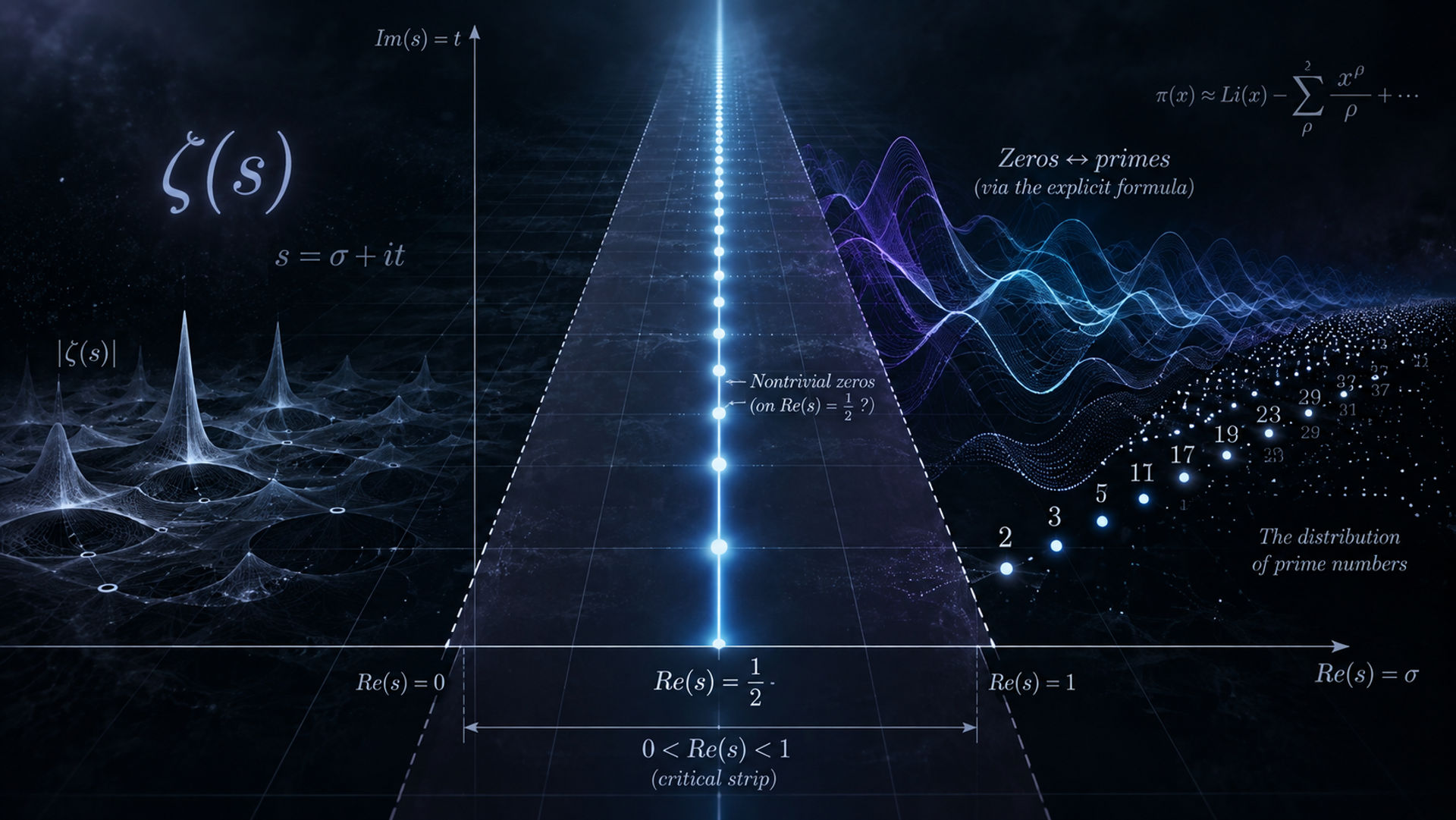
A rigorous accounting of proven theorems, computational evidence, and 2026's record-breaking bound — not another 'is it finally solved?' piece
What is rigorously proven about the Riemann Hypothesis, what recent record-breaking results actually show, and why the...
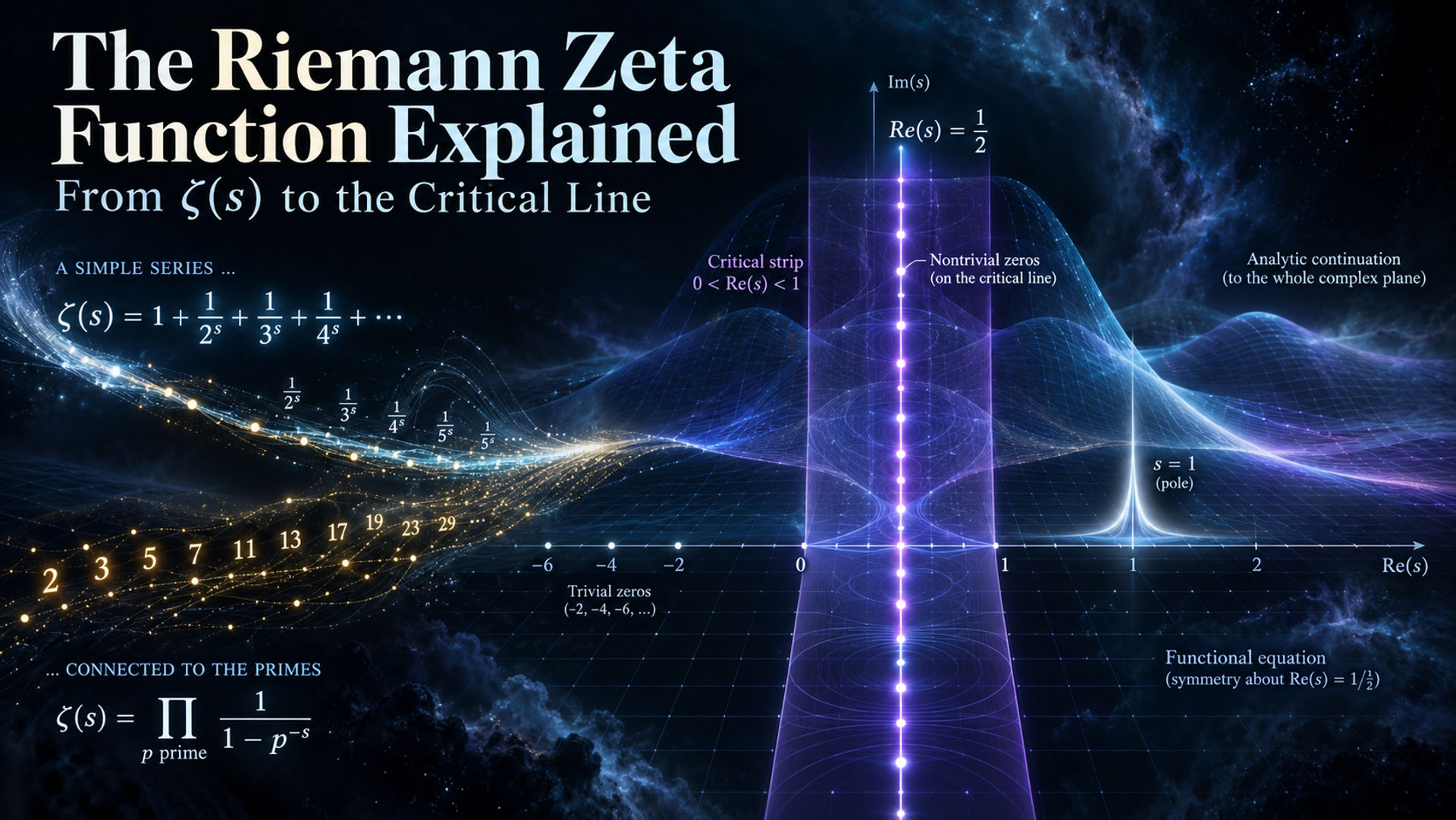
A first-principles primer on the function that ties prime numbers to the geometry of the complex plane
Starting from a simple infinite sum, we build up the Riemann zeta function, its analytic continuation, and the critical...

Superhuman engines have mastered practical chess. Mathematics has not yet proven what perfect chess is.
Stockfish and AlphaZero have mastered practical chess, but its true value under perfect play remains formally unproven...