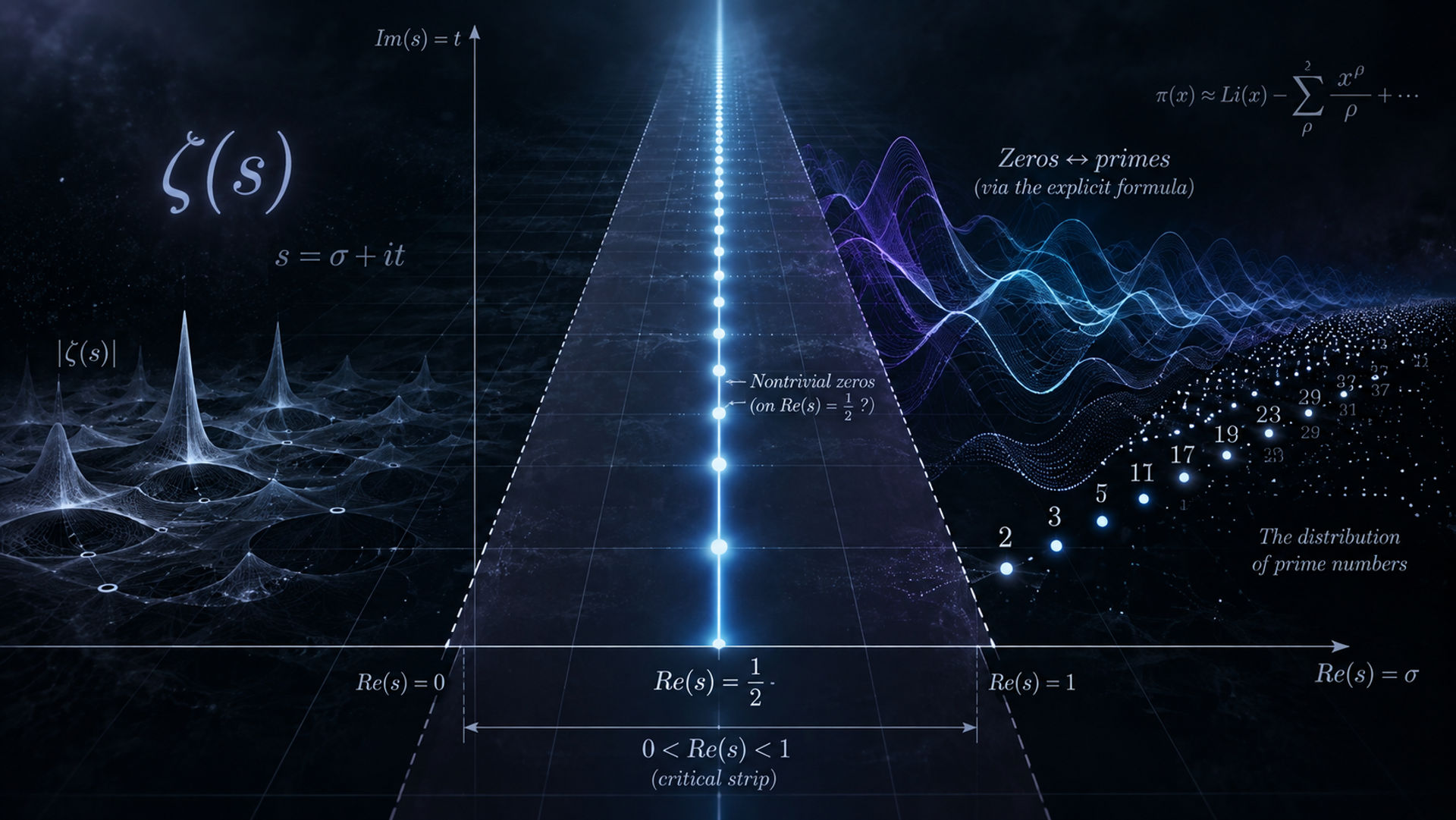
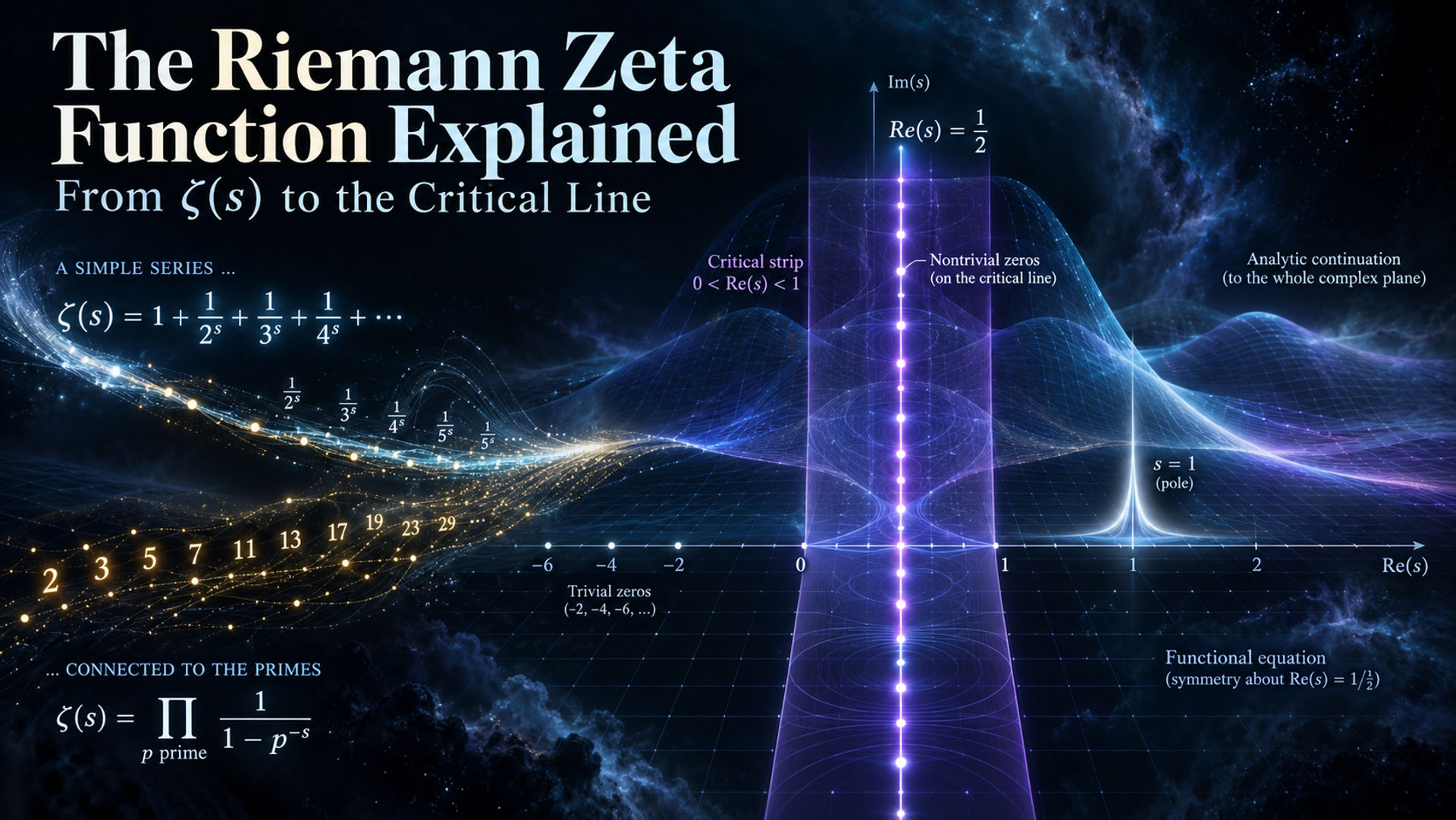
Let for , extended by analytic continuation to a meromorphic function on with a single simple pole at . The Riemann Hypothesis (RH) claims that every one of its infinitely many nontrivial zeros — the zeros of inside the critical strip — satisfies . Bernhard Riemann wrote down this claim in a single sentence in his 1859 paper on the distribution of primes, called it "very likely" true, and admitted he had not been able to prove it. One hundred and sixty-seven years later, nobody else has either.
ζ(s)=∑n=1∞n−s
Re(s)>1
C
s=1
ζ
0<Re(s)<1
Re(s)=1/2
That single unproven sentence sits at the center of analytic number theory because it is equivalent to the sharpest possible control on how the primes deviate from their average density. It is one of the seven Clay Mathematics Institute Millennium Prize Problems, the $1,000,000 bounty for its resolution remains unclaimed, and it is the only problem on Hilbert's original 1900 list of 23 that is still fully open. This article is not a status bulletin — MathLumen's 2026 status report covers what's new month to month. This piece is the structural companion: what has actually been proven, what computation has and hasn't shown, and why — mechanically — the problem keeps resisting.
What the Hypothesis Actually Says
For Re(s)>1, the Euler product
ζ(s)=p prime∏(1−p−s)−1
ties ζ directly to the primes. The functional equation
ζ(s)=2sπs−1sin(2πs)Γ(1−s)ζ(1−s)
extends ζ to the whole plane and reveals two families of zeros. The "trivial" zeros sit at s=−2,−4,−6,…, a direct consequence of the sin factor vanishing. The interesting zeros — infinitely many of them — lie inside the critical strip 0≤Re(s)≤1. Riemann's claim is that all of them sit exactly on the vertical line Re(s)=1/2, the critical line, bisecting the strip.
Why does the location of these zeros matter for primes? The explicit formula connects ψ(x)=∑pk≤xlogp (a weighted count of primes up to x) directly to a sum over the zeros ρ=β+iγ:
ψ(x)=x−ρ∑ρxρ−log(2π)−21log(1−x−2)
Each zero contributes an oscillating term of size xβ. If every β=1/2, every oscillation is exactly the same, minimal size x — the tightest possible error term in the Prime Number Theorem. If even one zero had β>1/2, primes would show detectable, larger irregularities at a scale tied to that zero's real part. RH is, in this precise sense, the statement that primes are distributed as regularly as the analytic structure of ζ permits.
What Is Rigorously Proven
Separating proof from evidence is the entire discipline here, so start with what mathematicians have actually established without any unproven assumption.
Infinitely many zeros on the line. G. H. Hardy proved in 1914 that infinitely many nontrivial zeros lie exactly on the critical line — the first unconditional foothold. Hardy and Littlewood later showed the count of such zeros up to height T grows at least linearly in T.
A positive proportion of all zeros. Atle Selberg went further in 1942, proving that a positive proportion of all zeros (not just infinitely many, but a nonzero fraction of the total) lie on the line. Norman Levinson's 1974 mollifier method pushed this to more than one third. Brian Conrey's 1989 refinement — still one of the most cited results in the field — established more than two-fifths (40.77%). Bui, Conrey, and Young raised this past 41% in 2011, and Pratt, Robles, Zaharescu, and Zeindler set what had been the standing record, 5/12 (41.66%), in 2020.
The 2026 jump to 67.25%. In August 2026, this record moved further than it had in the previous three and a half decades combined. An unreleased Anthropic research model, prompted by a non-mathematician staff member and left to work for roughly a day and a half across some sixty coordinated subagents, produced a 35-page manuscript proving that at least 67.25% of nontrivial zeros lie on the critical line, are simple, and that at least 83.625% are distinct. The argument does not introduce a fundamentally new method; it combines Montgomery's 1973 pair-correlation technique with more recent unconditional results by Baluyot, Goldston, Suriajaya, and Turnage-Butterbaugh, together with a 2000 result of Bombieri, in a combination the model's own account says had not previously been assembled. Anthropic's in-house mathematicians Levent Alpöge and Ralph Furman studied the argument, and analytic number theorists Brian Conrey and Daniel Goldston — the latter also a co-author of some of the underlying results the proof draws on — reviewed the manuscript on short notice. A companion Lean 4 formalization of the core result is public and passes standard mechanical verification.
This is a genuine, well-documented advance, and it is worth stating with equal clarity what it is not: it does not move the needle "67% of the way" toward RH, it does not constrain where the remaining roughly one-third of zeros might be, and as of this writing it has not been through peer review at a journal — the correct epistemic label is a public, unusually well-instrumented proof claim awaiting independent community scrutiny, not an accepted theorem. (Anthropic's own announcement is candid that it does not expect the underlying technique to extend to a full proof of RH.)
Zero-free regions. A second, older line of rigorous results shows that ζ has no zeros at all in certain regions approaching the line Re(s)=1. The classical de la Vallée Poussin-style region has the shape σ≥1−c/log∣t∣; the sharper Vinogradov–Korobov region has the shape σ≥1−c/(log∣t∣)2/3(loglog∣t∣)1/3. The best fully explicit constants, due to Mossinghoff, Trudgian, and Yang (2024), give c≈5.5587 in the classical form and c≈55.241 in the Vinogradov–Korobov form. These regions are unconditional theorems, not evidence — they prove a real, if narrow, band near the edge of the strip is provably zero-free.
A decades-old zero-density barrier finally broken. In 2024, Larry Guth and James Maynard proved a new bound on Dirichlet polynomials that yields the first improvement, in the critical range 1/2≤σ≤3/4, to Albert Ingham's 1940 zero-density estimate — a bound that had not moved in 84 years despite sustained effort, including Martin Huxley's 1972 refinement in a different range. A zero-density estimate bounds how many zeros can lie away from the critical line at a given height, without claiming there are none; the Guth–Maynard result (published in full form in 2026) shows there are fewer than previously provable, and it carries direct consequences for how short an interval is guaranteed to contain a prime.
What Computation Has Shown — and Why It Cannot Be Proof
Alongside these theorems sits a separate, much larger body of computational evidence. The most rigorous such record is due to Platt and Trudgian (2021), who verified, with full interval-arithmetic error control, that every one of the 12,363,153,437,138 nontrivial zeros up to height T=3,000,175,332,800 is simple and lies exactly on the critical line. Later, less formally certified computations by other groups have pushed spot-checks to far greater heights — on the order of 1013 and beyond in scattered intervals — without finding a single counterexample.
This evidence is real and it is not nothing: it rules out any exception at low height with certainty, and it constrains what a counterexample-producing mechanism would have to look like. But it cannot constitute a proof of RH, for a structural reason rather than a practical one. RH is a universal statement — every nontrivial zero, and there are infinitely many of them. No finite computation, however large, can verify a universally quantified claim over an infinite set. A single zero at height 1050 with Re(s)=0.5000001 would falsify RH outright and would sit far beyond the reach of any computation performed to date. This is the same logical gap that separates "we checked every even number up to 4×10¹⁸ and found it's a sum of two primes" from a proof of the Goldbach conjecture.
Recent Progress and the Discipline of Debunking
RH attracts more claimed proofs than perhaps any other open problem in mathematics, circulating regularly on arXiv, ResearchGate, and social media, and the community's response has become a discipline in itself. A representative pattern from the last few years: a preprint proposes proving RH via an "obstruction principle" spanning formal logic and spectral geometry, or via a novel integral representation, or through a reinterpretation of zeros as topological defects in some auxiliary bundle. These papers are not peer reviewed, are frequently self-published or hosted on preprint aggregators without editorial vetting, and have not been endorsed by the analytic number theory community. None should be treated as resolving the problem; a claimed proof of RH becomes credible only once it survives sustained, public scrutiny from specialists and, ultimately, peer review at a recognized journal — a bar essentially nothing claiming a full proof has cleared.
Separating this noise from genuine progress requires exactly the category discipline used throughout this article: a result is either (a) an unconditional theorem proved via accepted methods and checkable by experts, (b) numerical evidence with stated and verifiable error bounds, or (c) an unverified claim, however elaborate its apparatus. The Guth–Maynard zero-density theorem and the Pratt-et-al./2026 proportion-of-zeros results sit in category (a); the Platt–Trudgian computation sits in category (b); the recurring "I have proven RH" preprints sit in category (c) until — if ever — a recognized journal says otherwise.
Why It's So Hard
The difficulty is not merely that nobody has found the right trick yet; it traces to specific, well-understood obstructions.
The "conspiracy" problem. RH asserts that infinitely many, algebraically unrelated-looking quantities — the imaginary parts γ of the zeros — must all conspire to keep β=1/2 exactly. Proving a positive proportion (as Levinson, Conrey, and their successors have done) uses mollifiers: auxiliary Dirichlet polynomials constructed to detect zeros off the line and show there can't be "too many." This method has an intrinsic ceiling — the best mollifier constructions provably cannot push the proportion to 100% no matter how they are optimized, because the underlying moment estimates saturate. Reaching from "most zeros" to "all zeros" requires a genuinely different mechanism, not a better mollifier.
The error term feeds back on itself. The explicit formula linking ψ(x) to the zeros means that better information about the primes (a sharper Prime Number Theorem error term) and better information about the zeros are, in a precise sense, the same problem viewed from two directions. Every incremental gain — the Guth–Maynard zero-density bound, for instance — has to fight through the same handful of analytic bottlenecks: large-value estimates for Dirichlet polynomials, moment bounds for ζ, and the resolution of resonances between prime powers. Ingham's 84-year-old bound stood because those bottlenecks are genuinely resistant, not because nobody tried.
The function-field analogue is solved, and the transfer doesn't work. André Weil proved the analogue of RH for zeta functions of curves over finite fields in the 1940s, and Pierre Deligne extended it to higher-dimensional varieties in 1974 — genuine, celebrated proofs of an RH-type statement. The technique relies on the Frobenius endomorphism and the cohomology of algebraic varieties over finite fields, machinery with no known counterpart for Q. The Hilbert–Pólya conjecture — the hope that the zeros are eigenvalues of some natural self-adjoint (hence real-spectrum) operator, by analogy with how Frobenius eigenvalues control the function-field case — remains a guiding heuristic, strongly supported by the statistical match between zeta zero spacings and random matrix theory (the Montgomery–Odlyzko phenomenon), but no such operator has ever been constructed for the actual Riemann zeta function. Translating a proof strategy that works over finite fields into one that works over the integers has been, for eighty years, the central unsolved transfer problem in the field.
What a Proof Would Mean
A proof of RH would not just settle a curiosity. It would immediately sharpen the Prime Number Theorem's error term to its provably optimal form, ∣π(x)−Li(x)∣=O(xlogx), with direct consequences for how efficiently primality and factorization-adjacent algorithms can be bounded. A large body of published number theory is already conditional on RH or its generalizations to other L-functions (GRH) — bounds on class numbers, results in the Langlands program, and estimates throughout computational number theory — and a proof would convert all of that literature from conditional to unconditional overnight. A disproof, by contrast, would be equally seismic: it would mean the primes contain a detectable irregularity at some enormous but finite scale, undermining the heuristic that has underpinned analytic number theory since Riemann.
Where Things Stand
Going into the second half of 2026, the honest summary is this: RH remains open, exactly as it has for 167 years, and the Clay Institute's million-dollar prize remains unclaimed. What has changed is the density of genuine, checkable progress arriving in a short window — the Guth–Maynard zero-density breakthrough after an 84-year stall, and an unusually large single jump in the proportion of zeros provably on the line, produced with an unconventional AI-assisted workflow and backed by a public machine-checked proof, though still awaiting the peer review that would make it a fully accepted theorem. None of this brings a full proof of RH detectably closer in any way that can be quantified. What it does show is that the classical toolkit — mollifiers, large-value estimates, pair correlation — still has headroom nobody had located, more than three decades after the previous record. Whether the eventual resolution comes from that toolkit pushed further, from a genuinely new idea, or from formal and AI-assisted methods maturing enough to handle arguments of this complexity, is, as it has always been, an open question.