Table of Contents
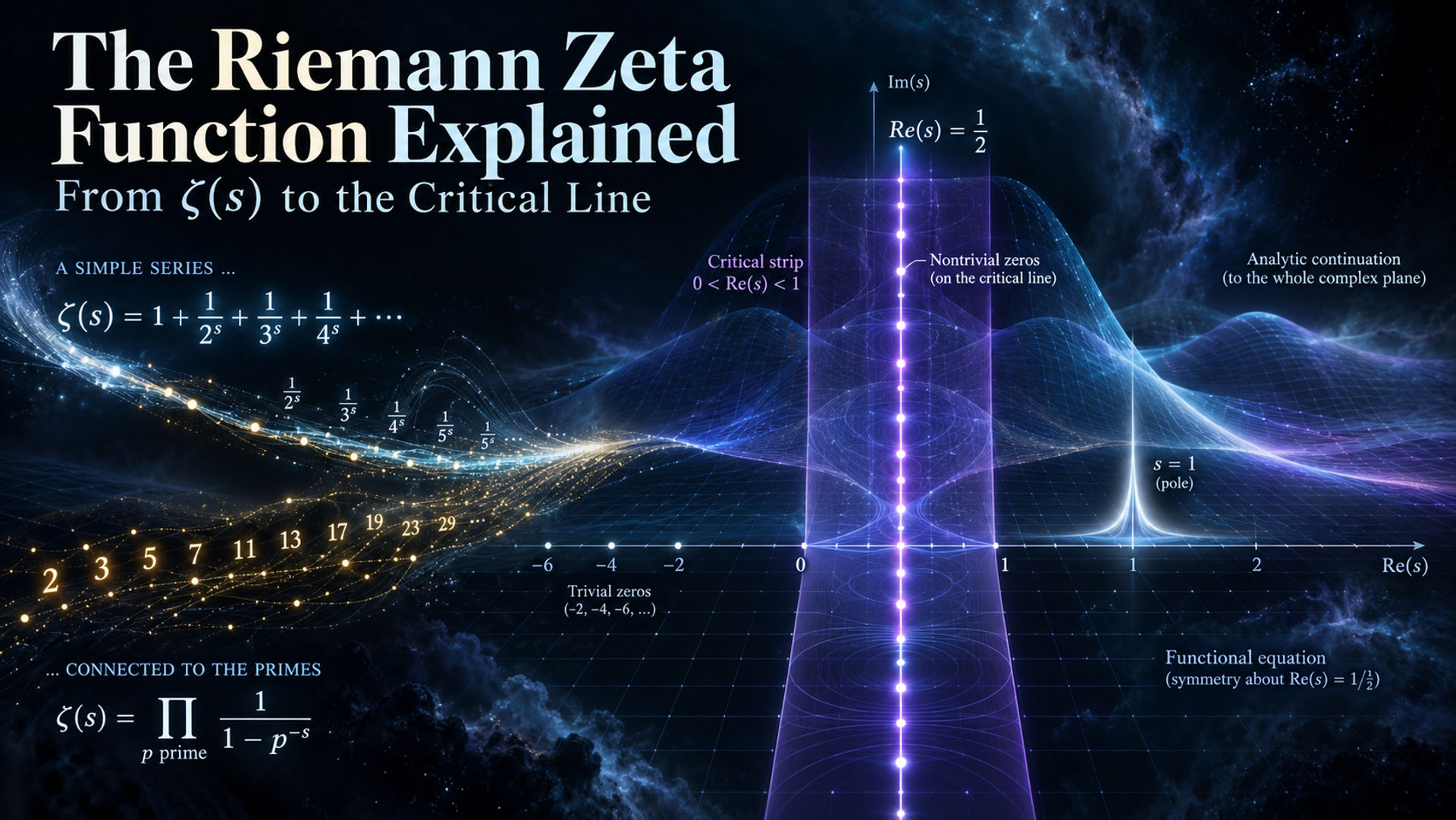
A first-principles primer on the function that ties prime numbers to the geometry of the complex plane

Consider the sum
For most values of you might try, this converges to some ordinary number. Add up enough terms and the value settles down. There is nothing here that looks like it should have anything to say about the primes — — which are scattered through the integers in a pattern no one has ever managed to describe with a simple formula.
And yet this sum, called the Riemann zeta function and written , turns out to encode the distribution of the primes so precisely that a single unresolved question about it — whether certain special points called its nontrivial zeros all lie on one particular vertical line in the complex plane — is considered one of the most important open problems in mathematics. That question is the Riemann Hypothesis. This article is not about the Hypothesis itself. It is about everything you need to understand before the Hypothesis makes sense: what actually is, why the definition above is not the whole story, and what the "critical line" and "critical strip" precisely refer to.
Everything in this primer — the definition, the fact that the sum must be extended beyond where it converges, the exact statement of the functional equation, and the location of the so-called trivial zeros — is proven mathematics, verified against standard references. Only one claim discussed here, right at the end, remains a conjecture. We will be explicit about exactly where that line is drawn.
For a real number , define
The condition is not optional decoration. It is what makes the sum converge. Take : the series becomes , the harmonic series, which grows without bound no matter how many terms you add. So does not exist as a finite number. For any , though, the terms shrink fast enough that the sum converges to a finite value — for instance, , a result Euler found in 1735 solving the "Basel problem."
Leonhard Euler studied this function over the real numbers well before Riemann. What Riemann did, in a nine-page paper delivered to the Berlin Academy in November 1859 titled "On the Number of Primes Less Than a Given Magnitude" ("Über die Anzahl der Primzahlen unter einer gegebenen Größe"), was extend the definition to complex values of and uncover what the function's behavior there reveals about the primes.
A complex number can be written , where and are real numbers and . The convergence condition "" generalizes to "," meaning the real part of — the in — must exceed . The imaginary part can be anything. So the series definition of is valid throughout the entire right-hand region of the complex plane where , and nowhere else.
The link to prime numbers appears through an identity Euler discovered, known as the Euler product formula. For ,
The reason this identity holds is the Fundamental Theorem of Arithmetic: every positive integer factors uniquely into primes. Expand each factor on the right as a geometric series, , and multiply all these series together across every prime . Because factorization into primes is unique, each positive integer appears as a term in the resulting product exactly once — no integer is missed, and none is counted twice. The infinite sum on the left and the infinite product on the right are two descriptions of the same bookkeeping.
This is the first hint of why matters for number theory: it is a single analytic object built entirely out of the primes. Any fact one can extract about how behaves is, at least in principle, a fact about how the primes are distributed. The Euler product converges, and this argument is valid, precisely on — the same region where the original series converges.
The trouble is that is a comparatively small and, for number-theoretic purposes, not very interesting region. The deepest information about prime distribution turns out to live closer to the line and beyond it — exactly where the defining series stops converging.
To see the breakdown concretely, let approach along the real axis. As , : the function has a genuine singularity, a pole, at , reflecting the divergence of the harmonic series. For more generally, the series simply diverges — the terms don't shrink to zero fast enough (or at all) for the sum to settle on a value.
So if we want to make sense of "" for — and we need to, since that is where the interesting structure lives — the series can no longer serve as the definition. We need a different route to the same function.
This is where analytic continuation enters, and it is worth pausing on the idea itself before writing down formulas.
Suppose you have a function defined only on part of its natural domain — here, defined only for — and you want to extend it to a larger domain in a way that is not arbitrary. For general functions, there could be many ways to extend a partial definition, all equally valid, all disagreeing outside the original region. But complex-differentiable functions (functions of a complex variable that are, in the appropriate sense, smooth) are far more rigid than that. A remarkable fact from complex analysis says that if a complex-differentiable extension of a function to a larger connected domain exists, it is unique. There is only one way to do it.
This means that once we know on , and we know it is complex-differentiable there, there is at most one way to extend it to a complex-differentiable function on a larger domain. Riemann found that such an extension exists, and that it can be pushed out to the entire complex plane, with a single exception: the point , where the pole cannot be removed. Wherever mathematicians write "" for a value of with — including negative integers, or , where a naive (and invalid) reading of the series would suggest — they mean this uniquely determined continuation, not the original divergent sum. The famous-looking statement "" is really a compressed, informal way of saying , a true fact about the continuation, dressed up in misleading notation borrowed from the series it does not equal.
Riemann's 1859 paper supplies the actual mechanism for the continuation: a functional equation relating the value of to the value of . In its classical form,
where is the Gamma function, the extension of the factorial to complex arguments ( for positive integers ). The precise combination of trigonometric, exponential, and Gamma factors is less important to internalize than what the equation does: it pairs up the point with the "mirror" point , reflected across the vertical line . If you know at every point with — where the original series works fine — the functional equation hands you the value at every corresponding mirror point, all of which have . Combined with direct analytic work filling in the remaining central strip, this yields a definition of valid everywhere except the pole at .
The functional equation was Riemann's own contribution; he proved it in the 1859 paper using tools including complex integration and Fourier-analytic techniques, building on Euler's earlier, more limited observations about special values of the series. It is also the source of a symmetry that will matter shortly: whatever the zeros of look like on one side of , the functional equation forces a mirrored structure on the other side.
A zero of is a value of where . The functional equation immediately reveals an infinite family of them. Look again at the right-hand side,
and ask when the factor vanishes: precisely when is an even integer. Checking which of these actually produce zeros of itself (rather than being cancelled by a pole of , which happens at the positive even integers) leaves exactly the negative even integers:
These are called the trivial zeros of the Riemann zeta function. They are called "trivial" not because they are unimportant mathematically, but because their location is fully understood and falls directly out of the functional equation — there is no mystery left to resolve about them. Every trivial zero is real, negative, and even; that is the complete list, proven fact, with nothing conjectural about it.
All the other zeros of — the ones not on that short, fully classified list of negative even integers — are called the nontrivial zeros, and they are where the real substance of the subject lives.
It is a proven fact, again following from analysis of the functional equation together with the Euler product, that every nontrivial zero satisfies
The Euler product formula, valid for , shows cannot vanish anywhere in that region — an infinite product of nonzero factors is nonzero. And the functional equation, applied at the mirror points, shows the same for , once the trivial zeros there are accounted for separately. What remains — the only place a nontrivial zero could possibly sit — is the open vertical band between and . This band is called the .
Picture the complex plane with the real axis running horizontally and the imaginary axis running vertically. The critical strip is an infinitely tall vertical band, of width exactly , with its left edge along the vertical line (the imaginary axis itself) and its right edge along the vertical line . Every nontrivial zero of , wherever it sits vertically, has a real part strictly between and — that is, it lies strictly inside this strip.
Running down the exact center of that strip, equidistant from both edges, is the vertical line
This is the critical line. It is the same line the functional equation uses as its mirror: reflecting across sends to . Every nontrivial zero found so far — and, at the time of writing, well over ten trillion have been checked computationally — lies exactly on this central line.
To summarize precisely what has been established versus what has not: it is proven that , once analytically continued, has a pole at ; that its only zeros outside the critical strip are the trivial zeros at the negative even integers; and that every nontrivial zero lies somewhere within the open strip . None of that is in dispute.
What is not proven — what remains, as of this writing, the single most consequential open conjecture in analytic number theory — is the much stronger claim that every nontrivial zero lies not just somewhere in the strip, but exactly on its central line, . That claim is the Riemann Hypothesis. Riemann himself stated it in the 1859 paper without proof, remarking only that it seemed "very probable."
With the definition, the continuation, the functional equation, and the critical strip and line now in hand, you have the complete vocabulary needed to follow why that remaining claim is so hard to settle, what partial progress towards it has looked like over the past century and a half, and what would follow from it if it were ever proven or disproven. For the historical and technical throughline of that story, MathLumen's comprehensive account of the Riemann Hypothesis covers what has been proven, what hasn't, and why the problem has resisted every attack for over 160 years. For the latest developments, partial results, and claimed progress, see our continually updated status report.

Applied mathematician and AI practitioner. Founder of MathLumen, exploring mathematics behind machine learning and scientific AI.
A rigorous accounting of proven theorems, computational evidence, and 2026's record-breaking bound — not another 'is it finally solved?' piece
What is rigorously proven about the Riemann Hypothesis, what recent record-breaking results actually show, and why the...

Superhuman engines have mastered practical chess. Mathematics has not yet proven what perfect chess is.
Stockfish and AlphaZero have mastered practical chess, but its true value under perfect play remains formally unproven...

When a computer checks every step, what does it mean to know something is true?
Mathematicians are now encoding entire research papers into Lean, a proof assistant that verifies logic at the level of...